
Field directors are feeling it in 2026. Voters are harder to reach by phone, answer rates are down, spam filters are stricter, and even great call lists do not guarantee real conversations. The result is a familiar frustration: your team is working hard, your dial time is high, but the number of meaningful contacts is not keeping pace.
Classic phone banking still matters. Many campaigns use campaign numbers, autodialers, and tools like Zoom, WiFi calling, or RingCentral to drive scale. When you need volume, these systems deliver. The problem is that scale does not always translate into quality. Unknown numbers are easy to ignore, and when voters do pick up, the conversation can be short, guarded, or rushed.
So what is the alternative?
Not a replacement for phone banking, but a supplement that is often underused because campaigns struggle to operationalize it: real relationships.
Phone banking vs friend banking
Most campaigns understand phone banking. Volunteers are given a list of voters, they call from a campaign number or autodialer, they follow a script, and the campaign tracks results.
Friend banking uses a different starting point.
Instead of handing volunteers a list of strangers, friend banking creates a personalized call list for each volunteer based on who they already know. Volunteers call their own contacts from their own phones. Those conversations are warmer and response rates are significantly higher, because friends answer friends.
This sounds obvious, but it is easy to underestimate how much it changes outcomes. A voter who ignores three unknown numbers will often pick up immediately when the caller is a neighbor, cousin, coworker, or someone from their community. And when they do answer, the conversation tends to last longer and end with a real commitment.
Why classic phone banking is getting harder
Phone banking has not gotten worse because campaigns forgot how to run it. It has gotten harder because the environment changed.
Voters receive more calls, more texts, and more spam. Carriers flag unknown numbers. People have learned to protect their attention. In practice, that means your best dialer setup is competing with every robocall and every scam attempt in the same inbox.
Campaigns respond by pushing volume: more dial time, more shifts, more numbers, more tools. But at a certain point, the marginal return drops. You add hours, but you do not add enough conversations.
Friend banking changes the equation because it shifts the trust barrier. It is not about reaching more people. It is about reaching the right people with higher probability of engagement.
Why friend banking works
Friend banking is effective for three reasons.
- First, it increases answer rates because the caller is recognizable and trusted.
- Second, it increases persuasion power. Voters are more open when the conversation is coming from a real relationship, not a campaign script delivered by a stranger.
- Third, it increases follow through. A commitment made to a friend carries more weight than a commitment made to an unknown caller. It is easier to ignore a campaign. It is harder to ignore a person you know.
This is also why friend banking pairs so well with a classic program. Phone banking is built for broad scale. Friend banking is built for depth and trust. Combined, they cover each other’s weaknesses.
The operational challenge: relationships are powerful, but messy
If friend banking is so effective, why do more campaigns not run it at scale?
Because it is hard to manage without the right system.
Relationships live in people’s phones, and field teams cannot easily see them, organize them, or turn them into a structured outreach program. Volunteers mean well, but without clear lists, prompts, and accountability, the program turns into vague encouragement: “call your friends.” That rarely scales.
The missing piece is turning relationships into an organized field program.
How UpVote friend banking makes it practical
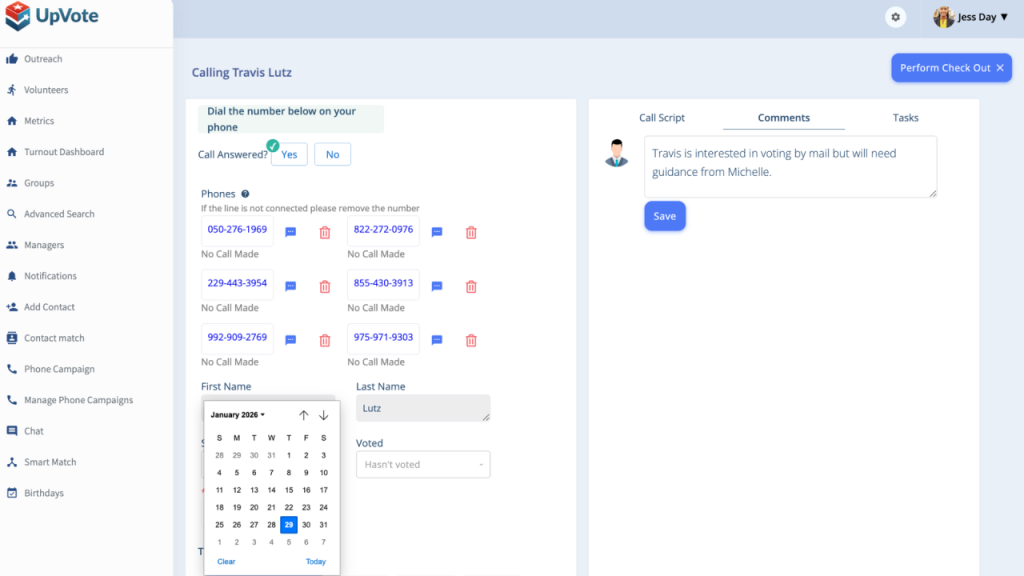
UpVote makes friend banking operational by creating a call list for each volunteer based on their own contacts, and then giving the campaign visibility into progress and outcomes.
Instead of guessing who a volunteer should call, the volunteer sees their own list. Instead of hoping outreach happened, the campaign can measure it. And instead of treating relational organizing as a side project, it becomes a repeatable system, with goals, scripts, and a clear timeline.
If you want to see how friend banking works in practice, here is a short video tutorial: https://youtu.be/5albVEUQUxs?si=_s3YSDCFvZ4Mwce3
And here is a visual guide for volunteers, including a downloadable PDF: https://up-vote.org/knowledge-base/phone-bank-guide-for-volunteers/
A simple way to combine both programs in 2026
If you already run phone banking, you do not need to overhaul your field plan. You can add friend banking as a high impact layer.
One simple approach:
- Use your dialer shifts to drive volume and ID support
- Use friend banking to deepen commitment, move undecideds, and drive turnout with trusted messengers
- Track both streams side by side so you can see what is producing real conversations and real commitments
Friend banking is not a silver bullet. It is a lever. In a cycle where attention is scarce, trust is one of the few advantages campaigns can still manufacture, if they build the system to use it.